Park Is a Latch, Not a Brake: Proving Transmission Hold Before You Trust the Ramp
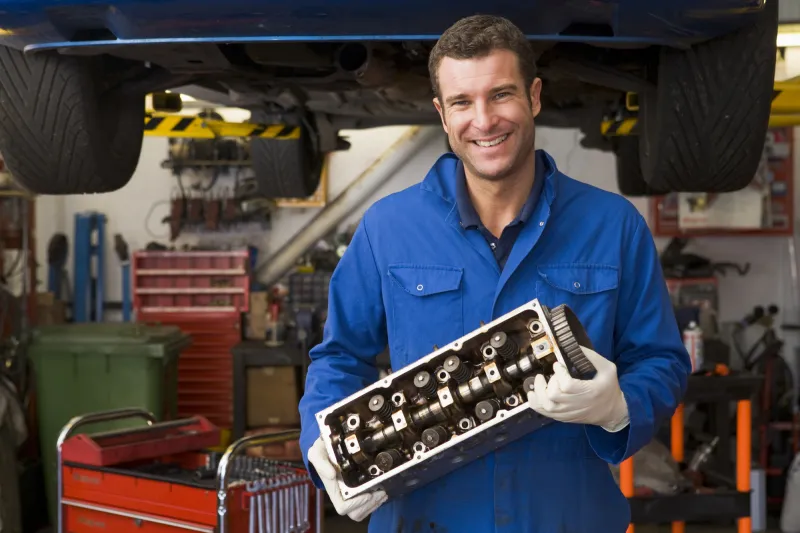
Photo: mechanic inspecting transmission parking pawl and shifter linkage under vehicle, via www.motorera.com
Park feels definitive. You roll into a spot, hear the click, let off the brake, and the car stays put. That click is not a brake clamping down. It is a parking pawl dropping into a toothed hub inside the transmission. When everything is right, that little latch carries the vehicle. When linkage is sloppy, a range sensor is lying, or the pawl is worn, Park can feel normal right up until it does not.
That is why a parking-pawl check belongs in the same category as a line-pressure test or a mount inspection. It is a diagnostic, not a formality. And because the failure mode is a rolling vehicle, the test has to be set up with more care than the repair itself.
Start With the Safety Setup, Not the Shifter
Do not test Park on a public ramp or a steep driveway with traffic behind you. Use level ground or a controlled shop area. Chock the wheels that stay on the ground, set the parking brake, and keep a second person clear of the vehicle path. If the vehicle is on a lift, make sure it is rated for the load, the arms are positioned correctly, and the locks are engaged. Wheels-free testing is useful, but only after the vehicle is stable.
On a lift, the cleanest check is to rotate the driveshaft by hand with the transmission in Park and the engine off. If the pawl is engaged, the shaft should not turn beyond a small amount of driveline lash. If it spins freely, Park is not holding the output. For four-wheel-drive and all-wheel-drive vehicles, confirm the transfer case is in a gear range that lets you test the transmission output, not neutral.
What a Healthy Engagement Should Feel and Sound Like
A healthy Park engagement is usually one solid click or thunk as the pawl drops in. You should feel a distinct detent at the shifter, not a mushy slot that lets the lever wander past Park. If you hear repeated clicking or ratcheting while the vehicle is still moving, stop. That is the pawl skipping across the teeth, and it is doing damage every time it happens.
A single hard engagement on a slight roll is normal enough. A grind, a crunch, or a lever that needs to be jiggled before it clicks is not. Those symptoms point toward cable stretch, a worn shifter assembly, a loose manual lever at the transmission, or a range sensor that is reporting Park while the internal manual valve is somewhere else.
Separate the Latch From the Electronics
The range sensor and neutral-safety circuit tell the computer and the starter what the driver selected. They do not physically hold the car. A vehicle can start in Park, light the Park indicator, and still roll because the manual valve or parking pawl is not actually engaged. That is the trap.
Check the cable or linkage at the transmission lever while a helper moves the shifter through the ranges. The lever should land firmly in each detent. If the cable is adjusted so the lever stops short of the Park detent, the shifter may feel fine while the rooster comb never drops the pawl in. Inspect the rooster comb, the detent plate inside the transmission, for worn teeth, a loose bolt, or a bent tab. Also confirm the manual valve moves with the lever. A valve that is disconnected or stuck will not direct the hydraulic circuit correctly, and Park may not engage even if the shifter and sensor agree.
When to Look Inside at the Pawl Itself
If the linkage is adjusted, the rooster comb is intact, and the range sensor is not lying, but Park still will not hold, the pawl or its spring is suspect. Depending on the transmission, the parking pawl may be visible after pan removal, or it may require more disassembly. Look for a broken return spring, a pawl tooth that is rounded or cracked, a damaged parking gear hub, or metal debris that is keeping the pawl from fully seating.
Do not ignore a pawl that engages but disengages hard. A vehicle that lurches when you pull the shifter out of Park on a slope is loading the pawl against the gear. That binding can bend linkage and chip teeth. The parking brake should take the load first, then the shifter should come out of Park easily.
Why Park Alone on a Ramp Is a Comeback Waiting to Happen
A parking pawl is a holding device, not a service brake. It is not designed to stop a rolling vehicle, and it is not meant to carry the whole weight of a truck on a steep grade while the driver works underneath. On a ramp, use wheel chocks, set the parking brake before shifting into Park, and turn the wheels toward the curb when parking on a hill. If the pawl is worn or the linkage is out of adjustment, Park can release under load or refuse to disengage when you need it to.
That is how a routine repair turns into a comeback: the technician trusts the click, the vehicle creeps, and now there is a bent trim piece, a damaged lift arm, or worse. Testing hold is cheap. Replacing a parking pawl, parking gear, or case is not.
Before the next ramp job, prove the latch. Check the engagement feel, verify the linkage and rooster comb, confirm the range sensor is not masking a mechanical problem, and inspect the pawl if the evidence points inside. Makco Transmission Parts carries the hard parts and rebuild pieces that keep Park acting like Park, not like a hope and a click.


