Stop Ordering Shift Solenoids Until You've Load-Tested the Transmission Ground
A customer rolls in with a shifted complaint and a scan tool full of solenoid codes. Maybe it's a P0751, maybe a P0756, maybe something vaguer. The solenoid has already been swapped, the fluid looks decent, and the pan is cleaner than expected. At that point, a lot of us start thinking valve body. But before you pull the pan or order a replacement solenoid, there's a less glamorous suspect worth checking: the ground path between the transmission case, the chassis, and the PCM.
A shift solenoid doesn't work in isolation. It needs power and a clean return path. If the ground side has resistance, the solenoid may chatter, drop out, or pull less current than the PCM expects. The result can look exactly like a lazy solenoid or a worn valve body. That's why a five-minute voltage-drop test belongs near the top of the diagnostic list, not at the bottom.
Why a Bad Ground Acts Like a Bad Solenoid
The PCM controls most shift solenoids on the ground side. It supplies voltage to the solenoid, then completes the circuit by switching the ground. If the transmission case has a poor connection to the chassis, or the PCM ground is compromised, the solenoid sees a voltage drop it never asked for.
The tricky part is that resistance doesn't have to be huge to cause trouble. A little corrosion under a bellhousing bolt or a green crusty strap can add enough resistance to upset a low-current control circuit. Cold weather makes it worse. So does road salt, especially in the rust-belt states where a transmission ground strap lives in a constant spray of winter brine.
When the ground is marginal, the solenoid may still click on the bench and still show the right resistance with a meter. That's why a simple ohms check can pass while the circuit fails under load. Voltage drop is the better test because it measures what happens while current is actually flowing.
What You Need, and What "Loaded" Really Means
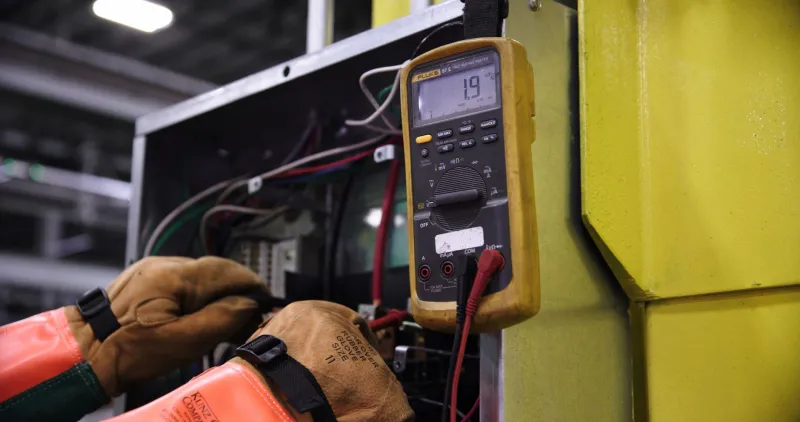
You don't need a lab. A decent digital multimeter with a min/max function is enough. A scan tool helps if you can command solenoids, but you can still do useful work with the key on, engine off, and a few electrical loads turned on.
The important idea is that a voltage-drop test only tells the truth when the circuit is loaded. Testing a ground with everything off is like checking a battery cable by looking at it. It might look fine. It might even read fine. But put current through it and the story changes.
For a transmission ground test, load the electrical system with the headlights on high beam, the blower on high, and the rear defroster on if the vehicle has one. If you can command the shift solenoids with a scan tool, do that too. On some vehicles you can also backprobe the solenoid control circuit at the PCM or transmission connector to confirm the PCM is actually grounding the circuit.
The Test: Battery Negative to Transmission Case
Set your meter to DC volts. Connect the red lead to battery negative. Connect the black lead to a clean spot on the transmission case. You want bare metal, not paint, not undercoating, not a greasy bellhousing bolt. A case bolt or a dedicated ground stud is ideal.
With the electrical loads on, read the voltage. Then watch the min/max while you wiggle the ground strap and harness. A good ground path should show very little voltage difference. As a practical ceiling, think 0.1 volt or less. Many manufacturers are stricter, especially on module grounds, so consult the service information if you have it. If you're seeing 0.2, 0.3, or more, you've found a real problem. That voltage is the difference between the battery negative reference and the transmission case, and the solenoid is paying for it.
Don't stop at one reading. Check the strap itself, the mounting bolts, and the contact surfaces. A strap can look fine from above and be hanging by three strands underneath. A bolt can be tight and still be insulated by paint or corrosion. If the reading jumps when you wiggle the cable, treat the connection as bad even if the average number looks okay.
Don't Forget the PCM Side of the Ground
The transmission case isn't the only ground in this story. The PCM has its own ground path, usually through wires to the engine block, fender, or chassis. If the PCM ground is weak, the module may not sink the solenoid circuit properly, and you'll chase the same symptoms from the other end.
Backprobe the PCM ground wires with the meter and load the circuit the same way. Again, you're looking for a small voltage difference under load. If the PCM ground shows more than a few hundredths of a volt while the system is active, clean and repair that connection before condemning any solenoid.
This is also a good time to check battery negative to engine block and engine block to chassis. Those are the foundation grounds. If they're bad, every downstream ground test becomes a guessing game.
Clean, Repair, or Replace?
If the voltage drop is high at the strap, start with a proper cleaning. Remove the strap, wire-brush both contact surfaces down to bare metal, and reinstall with clean hardware. A star washer can help bite through paint and corrosion. Apply a suitable anti-corrosion compound after assembly, not between the contact faces.
If the strap is corroded, frayed, or stiff, replace it. Ground straps are inexpensive compared with a valve body or a reman transmission, and a new strap removes doubt. Use the correct gauge and length, and route it away from exhaust heat and moving parts. On vehicles with a dedicated transmission-to-chassis strap, don't substitute a random wire from the drawer. Use a proper replacement rated for the current and environment.
After the repair, clear the codes and verify the fix. Run the vehicle through its normal shift sequence, check live data if you have it, and recheck voltage drop under load. If the code returns immediately, you may still have a solenoid or valve body issue, but at least you've eliminated the ground path instead of guessing.
A Five-Minute Habit That Saves Real Money
At Makco Transmission Parts, we sell plenty of solenoids and valve body parts. But the best diagnostic call is the one that finds the actual cause before parts get ordered. A loaded voltage-drop test from battery negative to the transmission case, and from the PCM ground to battery negative, takes about five minutes. It won't catch every shift complaint, but it will catch the ones that look like solenoid failures and aren't.
So before you order that next shift solenoid, grab the meter. Load the circuit, measure the drop, and wiggle the ground strap. If the ground path is clean, you can move on with confidence. If it isn't, you just saved a pan gasket, a solenoid, and a comeback.