The Bellhousing Doesn't Lie: Dialing In Runout Before It Eats Another Pump
You finally got the reman unit stabbed, the bell bolts torqued, the cooler lines bled. Two hundred miles later there's a whine that follows engine rpm, a fine gray paste on the drain plug, and a pump that's already chewed through a set of gears. The transmission gets blamed, a warranty claim gets filed, and the replacement does the exact same thing. That's the signature of a bellhousing that never sat concentric with the crank — and nine times out of ten the culprit is a pair of dowel pins nobody looked at.
Why Two Little Pins Do All the Work
Look at a bellhousing bolt pattern. There are six, eight, sometimes ten fasteners, and every one of them has clearance in its hole. None of them locate anything. Their job is clamping force. The actual positioning of the transmission relative to the crankshaft centerline comes from the dowel pins pressed into the block (or the adapter plate, or in some cases the bellhousing itself), mating with the corresponding holes in the bell.
That means the pins set concentricity for the converter pilot, the pump bushing, and the front pump gear set — all at once. Lose a couple thousandths there and everything downstream pays for it. Pins that are stretched, corroded, painted over, or simply left out during a rebuild are the quiet cause of a whole category of repeat failures.
The Failure Chain, In Order
Alignment problems don't fail dramatically, they fail sequentially. First the converter snout rides off-center in the pump bushing. The bushing wears oval. As clearance opens up, the converter starts to orbit slightly, which loads the pump drive tangs unevenly and puts a side load on the gear set. That's where the whine starts. Keep driving and the flexplate takes the abuse — you'll see cracked ring gear welds or a flexplate that's distorted around the crank bolt circle. Eventually the pump gear or the converter neck fails outright, and by then the whole unit is scrap.
Sometimes the first symptom is a leak at the front seal that won't go away no matter how many seals you install. Same root cause. The seal is round, the converter neck is running a small circle around it, and no seal in the world survives that.
Step One: Verify the Hardware Is Actually There
Before you drag out the dial indicator, pull the transmission and look. Both dowel pins should be present, seated fully, and free of galling. Measure them if you have calipers — a stretched or undersized pin will not locate anything. New pins are cheap; replacing them is the first move on any rebuild, and it's not optional on a high-mileage core.
Check the dowel holes in the bellhousing for elongation. If a bell has been run loose, the holes go oval and even fresh pins can't fix it. Check the block plate or separator plate too — it sits between the block and bell on most domestic applications and must be installed and flat before you measure anything. A bent or missing plate throws off both alignment and converter spacing.
Step Two: Measure Runout the Right Way
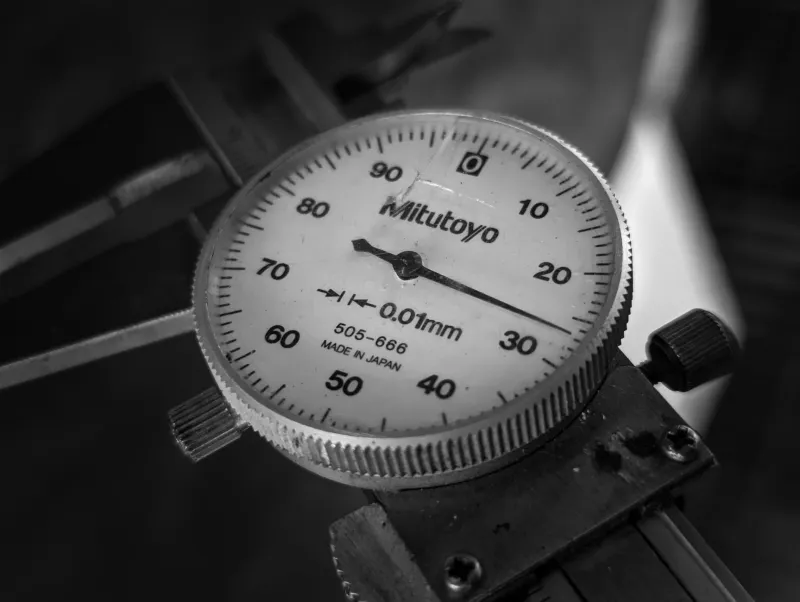
Bolt the bellhousing to the block with the block plate in place, torque the fasteners to spec, and make sure the dowels are engaged. Mount a magnetic-base dial indicator on the flexplate or crank hub, put the plunger on the inside of the converter pilot bore in the bell, and preload it about half a turn. Rotate the crank by hand through a full revolution and watch the needle.
Most domestic OEMs call for total indicator runout of about 0.005 inch at the pilot bore, with some platforms allowing 0.008. That's the whole budget, not a suggestion. If you're over, don't start shimming and hoping — find out which direction the bore is offset and correct it.
While you're set up, check face runout at the bell flange with the plunger on the mounting face perpendicular to the crank. Wobble here means the bell is bent or the block face is dirty, and no dowel adjustment will save it.
Reading the Number and Picking a Fix
If runout is out but the pins are good, offset dowel pins are the correct answer. They're available in common steps like 0.007, 0.014, and 0.021 inch, and you install them rotated so the offset pushes the bell toward center. Measure, install, re-measure. It's a five-minute job once you've got the indicator set up, and it's the only honest fix short of machining.
If the pins are fine, the bell is straight, and you're still out, look at the block. A block that's been line-bored, decked aggressively, or involved in a collision may have a dowel hole that's no longer true to the crank centerline. That's an alignment-plate conversation, not a parts-counter conversation.
The Mismatched Block Trap
Swap guys get bit here constantly. An LS bell on an older block with an adapter, a Ford modular pattern mated to a different plate, a mid-plate setup on a circle-track car — every one of those adds a joint that can stack error. "It bolted right up" means the holes lined up, not that the centerline did. Adapter plates in particular need to be checked for flatness and thickness, and the dowel arrangement between plate and block has to be confirmed before you trust anything downstream.
Performance builds are worse, because aftermarket bells and scatter shields often use their own dowel arrangement and their own runout spec. Follow the bell maker's number, not the OEM's, and document what you measured.
When It Really Is the Unit
Alignment isn't the answer every time. If runout is under spec, the dowels are new, the flexplate is flat, and converter spacing is within the recommended range, then a whine or a metal-filled pan genuinely points at the pump or converter. But you can't make that call from the driver's seat, and you can't make it from a warranty form. Measure first. A fifteen-minute dial indicator session is a lot cheaper than a second reman and a second R&R.
Keep a set of offset dowels on the shelf, keep a dial indicator within reach, and treat those two pins like the alignment system they are. Your pumps, your converters, and your flexplates will all live longer for it.