The Gauge Doesn't Guess: Line-Pressure Testing High-Mileage Automatics Before You Commit
Every tech has done it. Customer rolls in with a 190,000-mile minivan, says it flares between second and third, and the diagnosis starts forming in your head before the hood is up. Bad clutch pack. Maybe the valve body. Probably time to talk about a rebuild.
That's a guess wearing a lab coat. And the tool that turns it into an actual diagnosis costs less than a tank of gas.
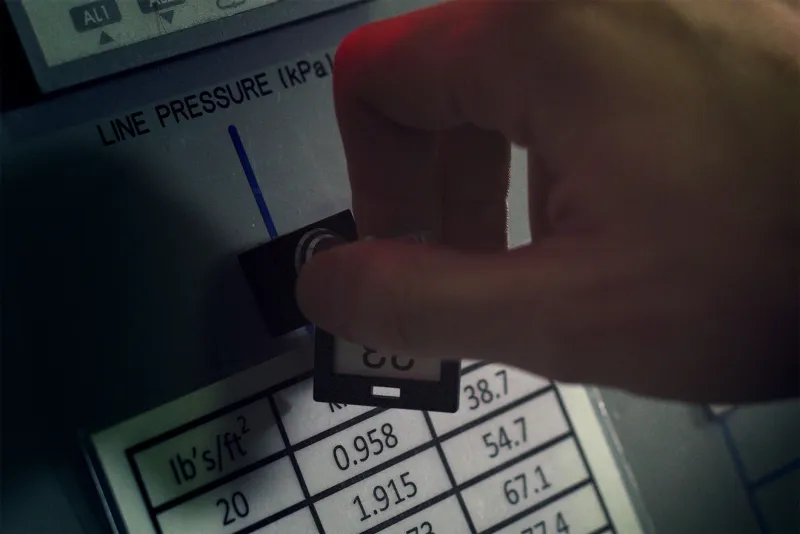
Line-pressure testing is not glamorous. There's no graph on a laptop, no freeze frame, no customer-friendly printout. It's a mechanical gauge, a length of hose, a hot transmission, and a spec. But it's the single fastest way to separate a hydraulic supply problem from a control problem from a worn-out hard part — and it costs you twenty minutes.
What Line Pressure Is Actually Telling You
Line pressure is the pump's output after the pressure regulator valve has done its job. It's the baseline pressure that feeds every circuit in the valve body, and it gets bumped up by throttle position or by an electronic pressure control solenoid as load increases.
So when you read it, you're really checking three things at once: is the pump healthy, is the regulator holding the right number, and is the control system asking for the right amount of boost. A low reading at hot idle that sags further in gear points somewhere completely different than a reading that's high across the board.
Read the Spec Before You Wrench
Pull the factory numbers first. You need three to five data points for most units:
- Hot idle in Park or Neutral
- Hot idle in Drive and in Reverse
- Pressure under loaded (brake-torque) conditions
- Pressure at the boost or wide-open-throttle spec, if the manual lists one
"Hot" means transmission fluid around 150–200°F. A cold reading is almost meaningless — pressure drops as fluid thins, and a pump that's marginal when cold will fall on its face once it's been on the highway for twenty minutes. Get the unit up to temperature and keep it there.
Ports, Gauges, and Hose
Most domestic automatics have a dedicated line-pressure port — a plugged 1/8 NPT hole on the case, often on the driver's side near the servo or pan rail. Consult the service info for your specific unit; some cases have multiple ports and testing the wrong one will send you chasing a ghost.
If there's no port, tee into a cooler line with the correct adapter fittings. Don't improvise with hose clamps on a 200-psi circuit unless you enjoy cleaning ATF off the shop floor.
On the gauge: a 0–300 psi liquid-filled unit covers most applications, though a 0–400 psi gauge is safer if you'll be testing under full boost. Use a quality hose rated well above your expected peak. And go easy on thread sealant — a shred of Teflon tape migrating into a valve body is a self-inflicted wound you'll be explaining for weeks.
The Test Sequence
- Verify fluid level and condition first. A clogged filter or a low sump will skew everything downstream.
- Connect the gauge, route the hose away from exhaust and moving parts, and secure it where you can read it from the driver's seat — or have a second person watch it.
- Record hot idle in Park or Neutral.
- Shift to Drive, hold the brake, and record.
- Repeat in Reverse.
- Load it against the brake for a few seconds and record. Keep it brief, keep the fluid from cooking, and let it cool between pulls.
- If the manual specifies a boost reading, capture that too.
Write the numbers down. Not "looks about right" — actual numbers on the work order, next to the ambient and fluid temps.
What the Numbers Are Pointing At
Low across the board, worse when hot. The pump is tired, the pressure regulator valve or its bore is worn, the pump seal is leaking internally, or the filter and pickup are restricted. This is a hydraulic supply failure, and no solenoid or valve body is going to fix it.
Normal at idle, drops under load. Classic weak pump or a suction-side air leak — a cracked filter neck, a bad O-ring, a pickup that's sucking air instead of fluid. Also worth checking the boost signal, since a stuck throttle valve or a lazy pressure control solenoid can leave the unit under-boosted.
High everywhere. Stuck pressure regulator valve, a pressure control solenoid stuck closed, a shorted or kinked harness, or the wrong solenoid installed. High line pressure hammers the accumulator and wears out clutch apply circuits fast, so don't ignore it just because the thing still moves.
Erratic or surging needle. Bore wear in the valve body, debris in the regulator, or a pump that's cavitating. Pair this with a pan inspection — a magnet loaded with paste tells a story all its own.
Normal pressure, still shifts badly. Now you've earned the right to look elsewhere: electronics, solenoid performance, clutch sealing, or an internal leak in a specific apply circuit. The pressure test just saved you from rebuilding a transmission whose pump was fine the whole time.
Pair It With What the Computer Sees
If the unit is electronic, watch commanded pressure control solenoid current against actual line pressure. A solenoid being told to raise pressure while the gauge stays flat is a solenoid, wiring, or bore problem. A gauge that climbs while the computer commands a low number points at a stuck valve or a misrouted harness.
When the Gauge Earns the Rebuild
Here's the practical value: if line pressure meets spec hot and under load, the pump and regulator are doing their jobs, and a rebuild quote based on "it flares" just got a lot harder to justify. If pressure is low and sagging, a valve body swap is throwing parts at a supply problem — and you'd have found that out for forty dollars and half an hour instead of a four-figure invoice.
Diagnostic discipline is mostly about order of operations. Pressure first, electronics second, hard parts last. The gauge doesn't guess, and neither should you.